Showing posts with label lewis gilbert. Show all posts

Wednesday, 9 November 2011

BlogalongaBond / The M To R
Of Awful Things In Moonraker

Of all the terrible things in the world for which Star Wars was responsible - George Lucas' constant tinkering, Jar Jar Binks, grown men dressing up as Jedi Knights - by far the most heinous was the blasting of James Bond into outer space. It wasn't entirely Star Wars' fault, obviously: it's mostly Cubby Broccoli's for listening to the cacophonous mooing that passes for public opinion. Space-based escapism was all the rage in the late 1970s, so what better way to cash in on the craze move the Bond franchise forwards than to wrap 007 in tin foil and fire him at the stars?

The trouble is, the general public have absolutely no idea what makes a good Bond film. They didn't even like On Her Majesty's Secret Service, the drooling cretins. And so Broccoli commissioned a script that was little more than Bond On Demand: a virtual remake of The Spy Who Loved Me (itself a virtual remake of You Only Live Twice) only in space instead of underwater, with incongruous references to other films for no apparent reason (The Magnificent Seven? Really?) and the transformation of a cold-blooded killer into a soft-hearted love machine because under-eights demanded it.
Promoting Moonraker, Broccoli wittered: "This isn't science fiction, this is science fact." Well, sorry Cubby, but this isn't science fact, this is science fucked. A man who falls out of a plane and lands on a circus is unlikely to survive without a scratch. The time between a space station being discovered by NASA and a platoon of fully trained Space Rangers arriving there to blow it up is unlikely to be six minutes. And a spy attempting to follow someone without being spotted is unlikely to succeed by hiding behind a glass vase. He's just going to appear slightly further away.
While Moonraker still isn't the worst Bond film so far (Lewis Gilbert's breezy direction keeps it from being as tediously leaden as Thunderball), it does have the dubious honour of having many of the worst things ever to appear in the franchise. To prove it, I was going to do the A to Z of awful things in Moonraker, but that would take so long it would be quicker to just watch the film again, so here instead is the, uh, M to R. That works, right?

M is for My God, what's Bond wearing?
While Roger Moore looks fairly sharp throughout most of Moonraker, he bookends the film with two of Bond's most alarming outfits: a blue blazer over a roll-neck sweater, the neck of which resembles a large, rolled-back foreskin - thereby making his head look like a massive, bewigged bell-end - and a yellow jumpsuit, the less said about which the better. What next, a clown outfit?

O is for Oh for God's sake

Presumably this is so Bond can identify his miniature spy camera amongst all the others cluttering up Drax's chateau.


O is for Onanism scene that explains plot hole
At the beginning of the film Bond is issued with a wrist-mounted dart-gun thingy, which saves his life early on and is probably one of Q's most useful inventions. Why he doesn't bother using it in any other life-threatening situation except to kill Drax right at the end, then, is a mystery. Perhaps he took it off so he could have a wank without firing an armour-piercing dart into his scrotum and forgot to put it back on again. There's a tragically missed opportunity for a "one off the wrist" gag somewhere there.

N is for Nicola Roberts from Girls Aloud
Not awful as such, just worth pointing out.

R is for Rubbish secret agent
In keeping with his professional desire to remain incognito at all times, Bond blends in with Venice tourists by driving through St Mark's Square on a massive hovering gondola with red and white stripes on it. This scene made my DVD player cry.

A is for Apparently this belongs in a James Bond film
In actual fact it doesn't.

K is for Kill me now


The romance evoked by the slow motion run and the pile of fresh corpses littering the surrounding area is almost palpable.

E is for Er, why is that guy hiding in a coffin?
Why shoot 007 from a safe distance with a sniper's rifle when you can customise a coffin with an arsenal of knives, float down a canal, take out a gondolier first then wait a moment before having a go at Bond, thus giving him the chance to do you in first? Henchman fail #372.

R is for Really? REALLY?
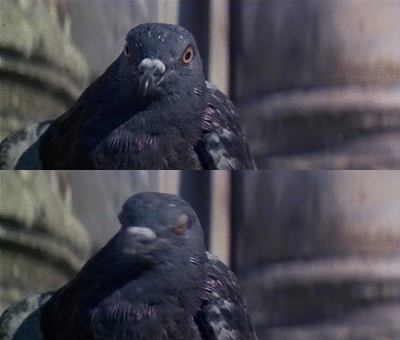
animated gif how to

The thing is, Moonraker isn't a bad film, it's just a bad Bond film. Take 007 out of it and you've got a perfectly serviceable, fun seventies romp. Maybe I'm being too po-faced - God knows the franchise shouldn't take itself too seriously - but double-taking pigeons don't belong in a film series that includes Sean Connery shooting a dead man in the back just to be sure.

Fortunately, and as is usually the case, it's not a complete disaster...

The death of Corinne Dufour
Having agreed to a little Dufour-play with 007, Corinne's only future career path as a Bond girl lies in certain death on the orders of her boss, Sir Hugo Drax. In the middle of a film full of crass double entendres and risible sight gags, the scene in which she's chased through the forest by Drax's dogs is weirdly stylish and poignant. Jean Tournier's long-lens photography is stunning, with dappled sunlight and dreamy slow motion offsetting the violence with unexpected class, while John Barry's urgent, menacing cue is one of his career best.

The stuntmen
Despite being jarringly intercut with blatant rear-projection shots of Roger Moore pretending to be in trouble, two of Moonraker's stunt scenes remain breathtaking. The pre-title skyfall was not only done for real by aerial mentalists BJ Worth and Jake Lombard, but done 88 times over five weeks to get all the required footage, while Richard Graydon actually dangled over the edge of that cable car in Rio without any kind of safety attachment, which is both heart-stoppingly terrifying and certifiably insane.

The bit where Roger Moore acts
Coincidentally, I pulled the exact same face throughout most of Moonraker

Having worn himself out developing a bit of character for Bond in The Spy Who Loved Me, Rodge reverted to his usual, eyebrow-waggling self in Moonraker. In a careless lapse, however, Moore accidentally acted a little bit during the scene where he goes for a spin in Drax's centrifuge trainer. The faces he pulls while being subjected to thirteen Gs are amazing enough, but when he emerges from the machine, sweaty and barely alive, it's the most physically unsettled we've seen Bond for a long time. His refusal to let Holly help him gives us another all-too-brief glimpse through a hairline crack in his steely veneer.

And finally: No cock joke this month, sorry, unless you count this poster:
In zero gravity, everyone can see your erection.

BlogalongaBond will return with For Your Eyes Only

Friday, 28 October 2011

BlogalongaBond / The Spy Who Loved Me:
Moore Starts Getting Bond Right

After the relative failure of The Man With The Golden Gun and the extraction of thorny co-producer Harry Saltzman from Cubby Broccoli's side, it was time to go back to the last boffo Bond for inspiration. With Ian Fleming only allowing the use of The Spy Who Loved Me's title (and not the story, which you should definitely read), Broccoli simply hired director Lewis Gilbert to virtually remake his previous Bond film, You Only Live Twice, but with Blofeld's name changed to Stromberg, and underwater instead of in space.

Despite all the shameless ripping off of himself, Gilbert delivers a Bond film which, for the most part, exceeds all expectations. It's Bond by numbers, but it's packed to the sprockets with spectacle and cracking action, and by this point we're so used to Bondian ludicrosity that we accept a villain with an underwater base and an indestructible idiot henchman with metal teeth named after a recent hit movie as if we pass them on the way to the shops every weekend.
The plot is, of course, ridiculous and convoluted (Bond must make contact with Sheikh Hosein in order to make contact with Aziz Fekkesh in order to make contact with Max Kalba in order to secure the MacGuffin) and the film's attempts to address the series' by-now-embarrassing misogyny are admirable but doomed to failure when Bond's female Russian "equal", Anya, is played by a plank of wood with tits and is required to completely reverse her stance on passion-driven revenge when Rodge raises one of those magnificent eyebrows.

Still, there is one thing that nobody expected to be as good as it was in The Spy Who Loved Me, and which is still overlooked today, and that's the occasionally surprisingly excellent performance of Roger George Moore. Don't get me wrong, he's still the worst James Bond, but once or twice a ray of brilliance shines through the clouds of crapulousness, and it's those that I'd like to celebrate here.

Where it took Sean Connery three films to find his sweet spot, Moore was comfortable in Bond's horsebit moccasins from the moment he unzipped that Italian chick's dress with his magnetic watch in Live And Let Die. It wasn't until The Spy Who Loved Me, though, that the combination of experience and a few choice nuggets of scripting gave him the chance to show that he was more than just two majestic arches of hair above a pair of twinkling, lecherous eyes. Take his fight with Oddjob-a-like Sandor on a Cairo rooftop: as Sandor holds onto Bond's tie for dear life, you can see Moore calculating how much tie is left before the teetering henchman falls, and the urgency of his questioning and callous dismissal of the bad guy with a brief hand movement are pure Fleming.

Probably Moore's single best moment as Bond comes as Anya reminds him - and us, for the first time since OHMSS - of his dead wife. Bond has clearly locked away all emotion for Tracy somewhere where it can fester in the pit of his soul, and Anya's mention of her causes a chilling reaction. Moore sits back slightly, backing away from a painful memory, then deploys a devastating eyebrow before fixing her with an ice cold stare and cutting her off mid-sentence. He touchingly admits sensitivity about the subject of his widowerhood and then, in an instant, defaults to jovial mode having buried his feelings even further down than before. The exchange lasts just ten seconds but within it Moore gives Bond more depth than in his previous four and a half hours in the role.
The scene also works to signpost a later one, in which Anya and Bond simultaneously realise that it was he who killed her lover in the pre-credits sequence. It's one of the best-written scenes in Bond history, and Moore again rises to the occasion. Bond knows what it's like to lose a loved one, and the weight of his loss and his empathy with Anya is visible even as he turns his back on her. His confession is unapologetic without being insensitive, and when she calmly informs him that she'll be killing him as soon as their mission is over, he gives a barely perceptible resigned nod, as if to say, "yes, I expect you will, and frankly I don't blame you". It's a shame Barbara Bach is so useless because with a better actress to trade off, this could have been one of the series' greatest moments.

Of course Rodge goes on to bugger it up several times during The Spy Who Loved Me, which is all the more frustrating when we know how good he can be, but for a few brief scenes he shows the world that anything Connery's nostrils can do, his eyebrows can do almost as well. But not quite.


The ski jump
Having just pulled off the greatest Bond stunt yet with a car that spins 360 degrees while jumping a river in The Man With The Golden Gun, Cubby Broccoli thinks nothing of immediately topping it with this outrageous piece of amazing nonsense. Directed by second unit chief John Glen, who would later direct five of his own Bond films, the stunt is the equivalent of the franchise pulling its trousers down and waving the world's most enormous cock and balls (with a Union Flag tattooed on the scrotum, natch) in the face of the moviegoing public, who gobbled it up. The parachute gag may be spectacularly dumb, offering any remaining villains a nice, bright target to aim at, but it was exactly what was required of Her Majesty's loyal terrier in Silver Jubilee year.

The music
With the Inland Revenue finding a few unpaid tax bills down the back of John Barry's sofa, it was left to Marvin Hamlisch to drag Bond strutting and pointing into the disco era with some astonishing funksplosions incongruously teamed up with a bit of Bach and Mozart, not to mention Maurice Jarre's Lawrence Of Arabia theme. And when I say "not to mention", I mean "let's not mention it". The score works though, Hamlisch's Cairo club music especially effective, and Carly Simon's title song is a thing of effortless beauty that revels in Bond's genital-waving superiority: baby, he's the best.

Ken Adam's sets
Having had a six-year break from Bond, the man who BUILT A FUCKING VOLCANO is back with his second-greatest ever set: the inside of a mind-bogglingly massive supertanker. You might think that you had a big idea once, but until a major film studio builds the world's largest stage in which to house it and gets Stanley Kubrick in to light it, your idea measures less than one ångström from end to end compared to this one. Go away and don't come back until you're Ken Adam.

Derek Meddings' models
If there's any indication of the breadth of skill involved in the making of The Spy Who Loved Me, it's the juxtaposition of Ken Adam's colossal sets with the models created by Derek Meddings. Meddings, having earned his stripes working on various Gerry Anderson TV series, created scale models of the Liparus (a 60-foot long 'miniature') and the submarines it swallowed, which blended seamlessly with Adam's monstrosities. He even mastered the art of realistic miniature water, which was still frustratingly tricky to get right in ye olde seventies. Combine all that genius (look at the wash behind the Liparus) with an expert knowledge of which lenses to shoot his models with for the most realistic result, and you begin to understand why Derek Meddings was given the Special Achievement Award for special effects at the 1979 Oscars.


And finally: Only a knob gag this terrible could make it into Alan Partridge's greatest ever Bond moment:

While entertaining 'Log Cabin Girl' with his penis, Bond receives an urgent message from M via his Dymotape-spurting watch. Bond dresses and makes to leave.

LOG CABIN GIRL
What happened? Where are you going?

BOND
Sorry darling, something came up.
I'll leave Alan's best friend Michael to sum this one up:


BlogalongaBond will return with Moonraker, God help us

What the hell is BlogalongaBond? I'll tell you.
Further BlogalongaBondareading here

Friday, 27 May 2011

BlogalongaBond / You Only Live Twice:
Sets Appeal

By 1967, the James Bond brand was so phenomenally popular that even if someone had produced an unofficial spoof 007 film with ten writers, seven James Bonds, six directors, one Ronnie Corbett and absolutely no redeeming features, it would still have become one of the year's highest grossing movies. Of course if such a movie were to exist, we would not speak of it here at The Incredible Suit, so let's move on.

The problem with this success was that it led to complacency: You Only Live Twice's screenwriter Roald Dahl was literally given a formula to stick to by producers Cubby Broccoli and Harry Saltzman, and Ian Fleming's macabre meditation on death was jettisoned in favour of a breezy Japanese jaunt that attempts to recapture all that was popular in the previous Bonds simply by lazy repetition. As a result, almost everything in the film is a faded copy of one of its predecessors:
Fortunately director Lewis Gilbert moves everything along with such a light touch and a sense of fun that it's easy to forgive the film's shortcomings. You Only Live Twice cheerily bounces from scene to scene being ludicrous and enjoyable, despite the best efforts of the script and cast to drag it back down to Thunderball-esque depths.

One man who didn't get the memo about kicking back, enjoying the sake and taking it easy, however, was the man responsible for You Only Live Twice's most memorable elements. Ladies and gentlemen, please rise for production designer Mr Sir Ken Adam OBE.
Adam's angular, modernist sets had already graced three of the first four Bond films, but it was on You Only Live Twice that he truly outdid himself. What's especially pleasing about his work on this film is that each of his sets is more impressive than the last, as if he was gradually building up to a grand, mind-blowing finale. Which, of course, he was.

I don't know about you but I can feel "a closer look" at the great man's work coming on.

Adam's first, simplest offering is the site of the antagonistic meeting between stereotypes representatives of the USA (bullish, arrogant) and the USSR (sly, threatening), chaired by global peacekeepers from the UK (statesmanlike, measured). Note the latticework design, simultaneously dividing and uniting the three parties. I've no idea what the massive hole in the floor denotes. Subsidence?

Henderson's Tokyo apartment is a mix of eastern and western influences, as befits a westerner living in Japan. Zaisu seats (cushions with chair backs) can be seen in the dining area - sitting seiza-style, as the Japanese traditionally do, is probably tricky with a wooden leg - while the next room contains more comfortable plush armchairs and a four-poster bed. All of which are about to become completely useless to their owner. Serves him right for serving Bond's martini "stirred not shaken", the galloping ninny.

Tiger Tanaka, essentially a Japanese M, has a much more modern office than his stuffy British counterpart. And whereas M's office is only ever really seen in the background of a character's close-up, Tiger's is afforded lingering wide shots to ensure every penny is on the screen. Adam fills the room with his trademark obscure angles and cheekily sneaks a tiger rug (GEDDIT?) into the middle of the room. I'm not sure what the giant Jenga's for. Maybe that's how Tiger relaxes after a hard day's ninja-ing.

Minor villain Osato's office HQ is an explosion in a perspective factory. Film sets rarely include ceilings because it makes them tricky to light, but Ken Adam doesn't give a shit about "rules". And when the ceiling is this amazing, quite right too. The office also features a personal dream of mine, a walk-in drinks cabinet, conveniently large enough to store unconscious henchmen.

The undoubted star of You Only Live Twice is SPECTRE's ludicrously unlikely but eye-poppingly amazing secret base, improbably carved into the guts of a volcano, and is as audacious a villain's lair as it is an achievement of set design. Neatly, its dome shape reflects Adam's first, simplest set in the film, but whereas that was designed to bring the USA and USSR together, the volcano's purpose is to force them into war with each other.

More than this, though, the volcano represents the peak of extravagance that the Bond series had reached. With this ridiculously over the top set, the films erupted through the crater of believability they'd been bubbling up towards for five years. While earlier Bonds still stand up to scrutiny today, You Only Live Twice became the launch pad for a million spoofs, and the only way the series could survive was by paring down the nonsense, ramping up the tension and going back to Ian Fleming's dark literary roots.
James Bond was about to undergo the biggest change of his life.


The Kobe docks fight
Bond beats off nineteen Japanese dockers with his bare hands (which is odd, given that he had a gun in the previous shot) and a big stick he finds lying around, in an amazing 22-second aerial shot. It's not a particularly impressive scrap - most of the henchfolk opt for a nice lie down rather than fighting back - but it makes a refreshing change to the way most fight scenes are shot. Having done all that, Bond then gets whacked on the noggin by a bad guy hiding behind some sacks. Sloppy.

The assassination attempt
In one of the series' most unnecessarily elaborate attempts on Bond's life (he's asleep! Shoot him!), a SPECTRE type trickles poison down a length of string toward's 007's snoozing chops, only for him to roll over at the last moment and for obligatory sacrificial lamb Aki to taste the deadly juice. Perfectly shot (the lighting on the poison is key to making the whole scene work), edited and scored, it's moments like this that make the Bond films so memorable. Grosse Pointe Blank's loving homage to this scene thirty years later proves its iconicness, which is definitely a word.

The cinematography
Having shot the first four Bond films, director of photography Ted Moore was replaced on You Only Live Twice by genius cinematographer Freddie Young, still basking in Oscar glory from Lawrence Of Arabia and Doctor Zhivago. He achieved the near-impossible task of successfully lighting the volcano interior, and romanticised the land of the rising sun to the point where, despite Connery's alarming Japanese "disguise" and unflattering turtle neck sweater, this may well be the most beautiful Bond film of all.

And finally: The one thing Thunderball lacked the most is back:

In Tanaka's bath-house, Bond is attended to by a bevy of bikini-clad beauties, who lather him up with foamy bubbles. Bond glances towards his crotch:

JAMES BOND
Don't get the soap in my eye, will you?

And even more finally: Mie Hama, who plays Kissy Suzuki, took such a fascinating path to making You Only Live Twice that somebody wrote a song about her many years ago. It didn't make it into the charts and its creator now lives a sad and pathetic life writing about films on the internet for a tiny and long-suffering readership.

"Face Like A Pig"


BlogalongaBond will return with On Her Majesty's Secret Service

What the hell is BlogalongaBond? I'll tell you.
Further BlogalongaBondareading here